
17.04.2026
For the first time, a landmark joint study by FAO, the ILO and the Thünen Institute of Forestry delivers global, sex-disaggregated employment estimates for the forest sector — offering policymakers, industry stakeholders and civil society a far sharper lens through which to understand who works in the world's forests, and under what conditions.
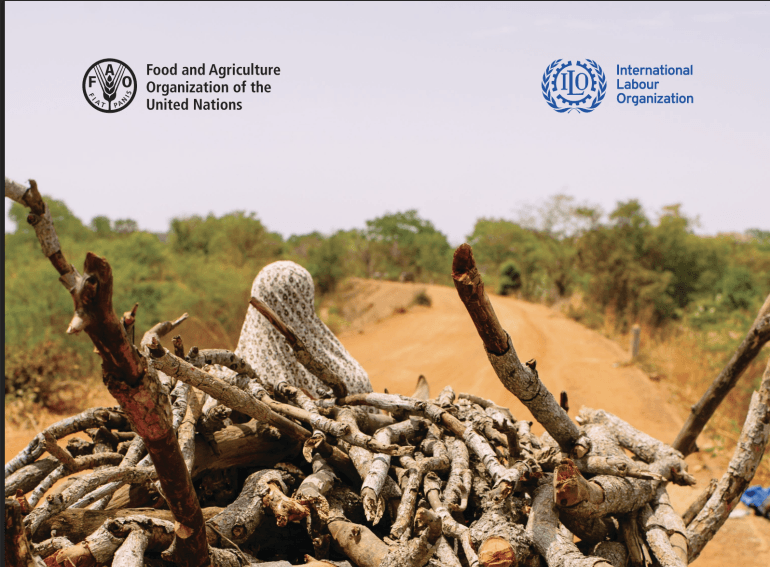
A new era of data transparency has arrived for the global forest sector. Published on 14 April 2026, Updated Methodology to Quantify Forest-Sector Employment: Global and Regional Estimates is a joint report by the Food and Agriculture Organization of the United Nations (FAO), the International Labour Organization (ILO) and the Thünen Institute of Forestry. It represents a major step forward in the quality, consistency and comparability of employment data across the forest sector — and the first-ever global study to disaggregate these figures by sex.
A sector that employs millions — with persistent inequalities
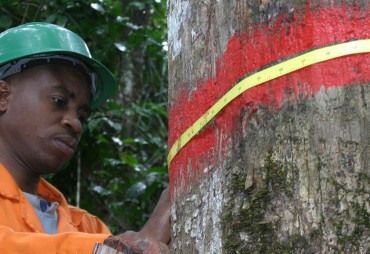
Forests employ approximately 42 million people worldwide, with women accounting for one quarter of the workforce. This figure represents around 1.2% of total global employment. While the headline number is significant in itself, it is the gender dimension of the data that breaks genuinely new ground.
The study reveals that women account for nearly 10.6 million jobs, or 25% of forest-sector employment, and highlights persistent disparities between women and men across regions. The widest gap was found in Europe, where 1.8% of men and only 0.5% of women were employed in the sector in 2022. By contrast, disparities were narrower in Africa, the Americas and Asia — a finding that should prompt reflection among both public authorities and private sector actors in Europe and beyond.
A new methodology fit for global ambition
The study's analytical backbone is the newly developed Forest EMployment (FEM) model, designed to improve the availability and consistency of forest-sector employment data by generating annual, sex-disaggregated estimates for the forest sector and its subsectors, providing a more robust evidence base for policy and analysis.
Drawing on annual data for the sector and its subsectors across 182 countries — representing 99% of the world's forest area — the model introduces several methodological improvements compared to previous estimates, including annual figures instead of three-year intervals, and the use of country-specific socioeconomic and demographic characteristics, labour-market indicators and forest-sector variables to estimate missing data.
Subsectoral breakdown: wood manufacturing leads
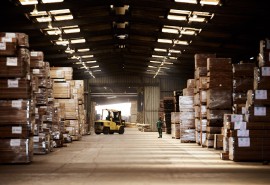
The report also sheds light on the distribution of employment within the sector. Wood and wood product manufacturing accounts for the largest share — approximately 58% of total forest-sector employment — followed by forestry and logging (33%) and pulp and paper manufacturing (16%). These figures are of direct relevance to ATIBT members and partners operating across the tropical timber value chain, as they contextualise where jobs are concentrated and where gender disparities may be most pronounced.
A global trend of slight decline
The sector employed at least 42 million people worldwide in 2022 — around 1.2% of total employment — representing a decline of approximately 3.1% compared to 2011. Regional trends vary: Asia continues to account for the largest share of forest-sector employment in total employment (around 1.4%), while Africa saw fluctuations — starting at 1.2% in 2011, peaking in 2016, and decreasing to 1.0% by 2022 — and employment levels in the Americas remained relatively stable at around 0.8%.
Why this matters for ATIBT and its members
For ATIBT — whose mission centres on promoting the responsible and sustainable management of tropical forests as a driver of development — this report is a valuable reference. It underlines that the forest sector is not only an environmental asset but a significant source of livelihoods, particularly in tropical regions. The availability of sex-disaggregated data for the first time opens new avenues for dialogue on inclusive forest governance, workforce development, and the social dimensions of certification and legality frameworks.
As FAO Assistant Director-General Zhimin Wu noted, "to help build a more sustainable and resilient forest sector, we need a clear picture of who works in our forests — and that starts with sex-disaggregated data."
ATIBT encourages its members and partners to consult this report and consider how its findings can inform their own practices, reporting and engagement with public authorities.
Download the full report: Updated Methodology to Quantify Forest-Sector Employment: Global and Regional Estimates — FAO/ILO/Thünen Institute, 2026