
13.05.2026
On April 23 and 24, 2026, Cameroon’s Ministry of Forestry and Wildlife (MINFOF) organized a national workshop in Yaoundé to present findings, analyze, and plan CITES actions on flora, with support from ATIBT and its partners.
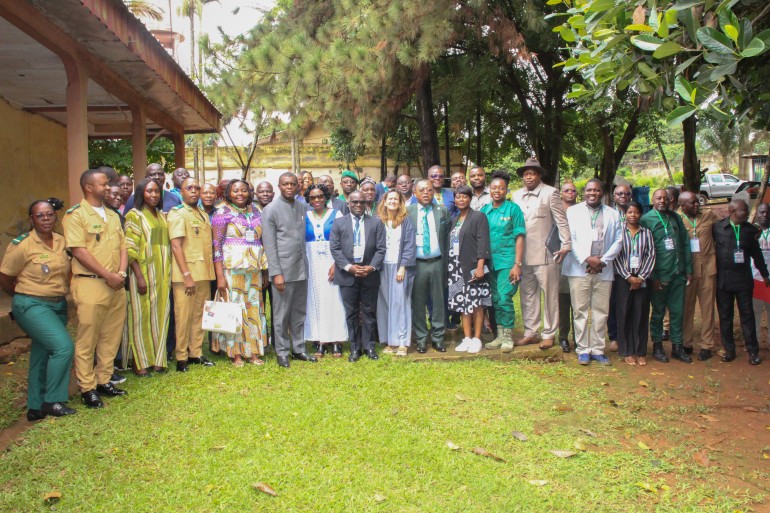
Bringing together some sixty national and subregional stakeholders, this meeting provided an opportunity to review the results of the RESSAC project, scientific advances regarding the genus Guibourtia, lessons learned from CoP20, and Cameroon’s strategic priorities for the 2026–2028 period.
The workshop took place against a backdrop of increasing international requirements regarding the sustainability, traceability, and legality of the tropical timber trade. The gradual listing of several commercial timber species from Central Africa in CITES Appendix II—notably Afzelia spp., Khaya spp., Pterocarpus spp., and Guibourtia spp.—now requires producing countries to demonstrate that international trade is based on sound scientific grounds and does not threaten the survival of the species.
The meeting brought together the main relevant government agencies (MINFOF, MINCOMMERCE, MINREX, MINFI, MINEPIA), scientific and academic institutions, the private forestry sector, civil society, and several international technical and financial partners, including the European Union, GIZ, FAO, IUCN, CIFOR-ICRAF, and TRAFFIC. Representatives from Gabon, the Republic of the Congo, and the DRC also participated in the discussions, illustrating the growing regional dimension of CITES issues in the Congo Basin.
The first day was devoted to presenting the results of the RESSAC project (“Research in Ecology and Social Sciences for the Sustainable Management of Forest Ecosystems in Central Africa”), funded by the European Union through CIFOR-ICRAF and implemented by a consortium comprising the University of Liège, the University of Dschang, Rougier Gabon, and ATIBT.
The project analyzes the economic, institutional, and social impacts of CITES implementation on forestry companies, public administrations, and local communities in Cameroon and Gabon. The initial results presented highlight in particular:
· increased administrative burdens for companies;
· significant delays in the issuance of permits;
· the need for technical capacity building;
· difficulties in institutional coordination; · as well as certain indirect economic impacts on communities dependent on forest resources. Discussions also underscored the importance of strengthening the scientific basis for Non-Detriment Findings (NDFs), traceability systems, and monitoring mechanisms for CITES-listed species.
The afternoon of the first day focused on scientific work related to the genus Guibourtia. Participants discussed species delineation, identification criteria, their geographic distribution, as well as the implications for NTPs, traceability, and the issuance of CITES permits.
This work represents an important step toward improving the reliability of field identifications and securing the supply chains of forestry companies.
The second day provided an opportunity to review the key takeaways from the CITES CoP20 held in Samarkand, particularly the growing pressures regarding new Central African timber species such as Okoumé or certain species of the genus Entandrophragma.
Participants then analyzed Cameroon’s future CITES Flora Action Plan 2026–2028, structured around strengthening scientific capacity, improving traceability systems, developing ACNPs, and preparing national positions for CoP21. The workshop concluded with the collective approval of a Budgeted Annual Work Plan defining operational priorities, stakeholder responsibilities, and next steps.
Through the RESSAC project, ATIBT is thus continuing its commitment to CITES implementation based on robust scientific data, dialogue between government agencies, researchers, and the private sector, as well as greater consideration of the economic realities of producer countries in the Congo Basin.