
30.04.2026
On 24 April 2026 in Kuala Lumpur, the “Trade and Markets Day” brought together major players in the timber industry on the sidelines of the ITTO Asia-Pacific Regional Training Workshop on CITES Non-detriment Findings. ATIBT was represented through its Director of Innovation and Strategy, alongside leading international experts. A summary of the key issues discussed.
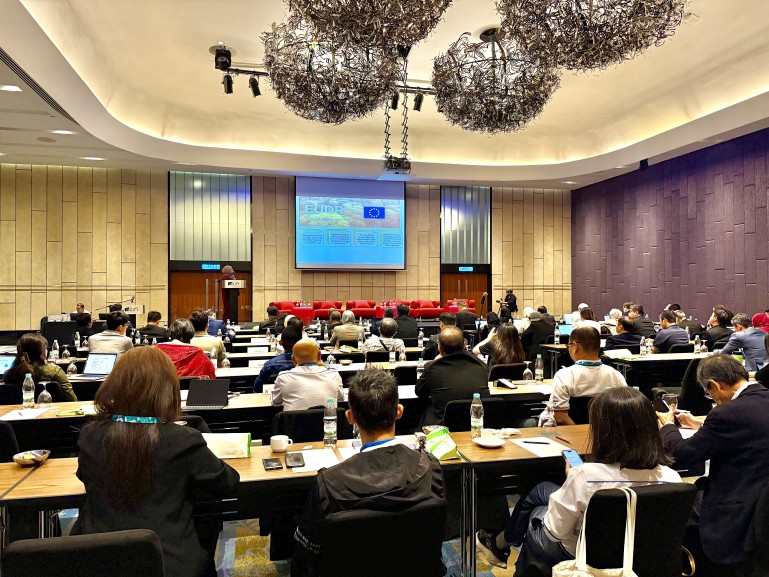
24 April 2026 – Aloft Hotel, Kuala Lumpur, Malaysia – in partnership with the Ministry of Plantation and Commodities (KPK) of Malaysia
The day opened with a keynote address by Professor Herry Purnomo (CIFOR Indonesia), who highlighted that global demand for timber is expected to increase by 37% by 2050. Against a backdrop of climate change and tightening environmental regulations, he underlined the growing difficulty of ensuring reliable supply chains and full traceability — particularly for timber sourced from smallholders — and called for stronger coordination between public instruments, such as the Indonesian SVLK+ system, and private sector initiatives.
The EU Deforestation Regulation (EUDR) was central to the morning’s discussions. Caroline Duhesme (Director of Strategy and Innovation - ATIBT) outlined the regulation’s four core requirements: zero deforestation, legality, geolocation and due diligence. She emphasised that FLEGT licences, while covering the legality dimension, are not sufficient on their own to meet EUDR requirements. She also stressed that sustainable forest management (SFM) certification represents a comprehensive tool — covering several core aspects of the regulation, including legality, risk mitigation and traceability — but remains undervalued within the current European regulatory framework.
PEFC, represented by the Malaysian Timber Certification Council (MTCC) through Dr. Farah Shameem, presented its tools for EUDR alignment: a revised sustainable forest management standard (ST 1003:2024) and a due diligence system (DDS) module integrating geolocation data collection, developed in partnership with technology providers LiveEO and osapiens.
Two technological approaches attracted particular attention. Dr. Arif Malik (Adelaide University, ADIFF Laboratory) presented stable isotopes-based timber identification methods, notably through the World Forest ID initiative, which is building a global open-access reference database to improve supply chain transparency. Dr. Yong Hau Tay (Agritix / Xylorix) showcased an AI-powered automated identification solution, Xylorix, which can be used in the field via a macro lens on a smartphone. A promising first-line screening tool — though one that does not replace laboratory wood anatomists.
Three supplying countries shared their experiences. Malaysia (Malaysia Timber Council) is contending with weak demand, high compliance costs and logistical disruptions linked to geopolitical tensions. The prospect of a potential CITES Appendix II listing for Meranti (Shorea species) is viewed as a serious threat to its exports.
Indonesia, whose forestry exports reached approximately USD 12.78 billion in 2025, has integrated geolocation requirements into its SVLK system (now SVLK+) and is actively diversifying its markets towards South Asia, Africa and Eastern Europe.
Vietnam, meanwhile, has pursued a transition towards plantation forests and value-added product manufacturing, with flexibility and innovation as its guiding principles — although plantation cycles remain relatively short (often 4–6 years), raising questions about long-term resource sustainability.
The afternoon shed light on two additional sources of uncertainty. Dr. Steve Johnson detailed the compliance challenges faced by Asian countries in issuing CITES Non-detriment Findings (NDFs) and export permits, and presented the CTSP II programme, funded by Germany, which supports the strengthening of scientific and monitoring capacities in relevant countries.
Joseph O’Donnell (IWPA) analysed the complex US trade landscape under Trump 2.0, marked by the use of tariff instruments (notably under Sections 122 and 232) as well as anti-dumping and countervailing duty (AD/CVD) investigations specifically targeting hardwood plywood imports from Asian countries.
The day concluded with a panel discussion moderated by Ms. Sheam Satkuru, bringing together the afternoon’s speakers to explore the synergies between CITES, trade and market requirements. A rich exchange that underscored the growing complexity of the environment in which the certified tropical timber sector operates — and the need for industry stakeholders to remain actively engaged at the international level.