
30.04.2026
A paper published in April 2026 in the peer-reviewed journal Trees, Forests and People calls for a rethink of Africa’s forest trade model. Led by Astrid Zabel (University of Bern) and co-authored by experts from ten African countries, it includes among its authors Nathalie Bouville, ATIBT’s Communication and Marketing Manager — a contribution that reflects our association’s commitment to shaping the scientific debate on the future of Africa’s forest sector.
Africa exports raw timber and imports processed wood products. This imbalance has generated a cumulative trade deficit of nearly USD 66 billion between 1992 and 2020. As international markets grow increasingly complex — the EU Deforestation Regulation (EUDR), fluctuating US tariffs, mounting pressure on supply chain legality — the continent has every reason to look inward.
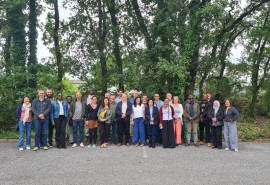
This is the central argument of the paper, developed during a community of practice jointly facilitated by the African Forest Forum and the Centre for Development and Environment at the University of Bern. The authors identify six complementary approaches: expanding timber plantations on degraded land, strengthening certification (FSC, PEFC), supporting small and medium-sized enterprises, investing in low-emission transport infrastructure, combating corruption, and raising awareness of the sector’s untapped economic potential among private investors.
The African Continental Free Trade Area (AfCFTA), which came into effect in 2021, provides an unprecedented institutional framework to turn these ambitions into reality. According to the Economic Commission for Africa, wood and paper are among the sectors set to benefit most from the development of regional value chains.
Read the full article (open access):
Zabel A. et al. (2026). Boosting intra-African timber trade. Trees, Forests and People, 25, 101267