
04.09.2026
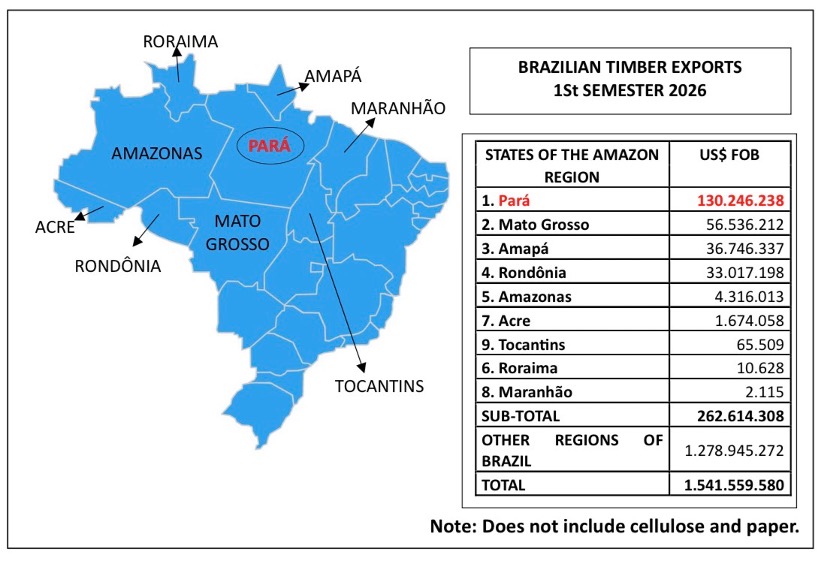
Brazil’s leading state for timber exports from natural forests, Pará has profoundly transformed its timber sector by shifting towards higher value-added products. With exports exceeding US$130 million in the first half of 2026, the sector continues to demonstrate strong momentum, while navigating an international environment marked by significant economic, trade and regulatory uncertainties.
The state of Pará is the second largest Brazilian state in terms of geographic size, with an approximate territorial area of 1,245,832 km², and is the largest exporter of tropical wood from native forests in Brazil, behind only the states of Santa Catarina, Paraná, and Rio Grande do Sul, whose production base is planted forests, mostly of pine and eucalyptus species.
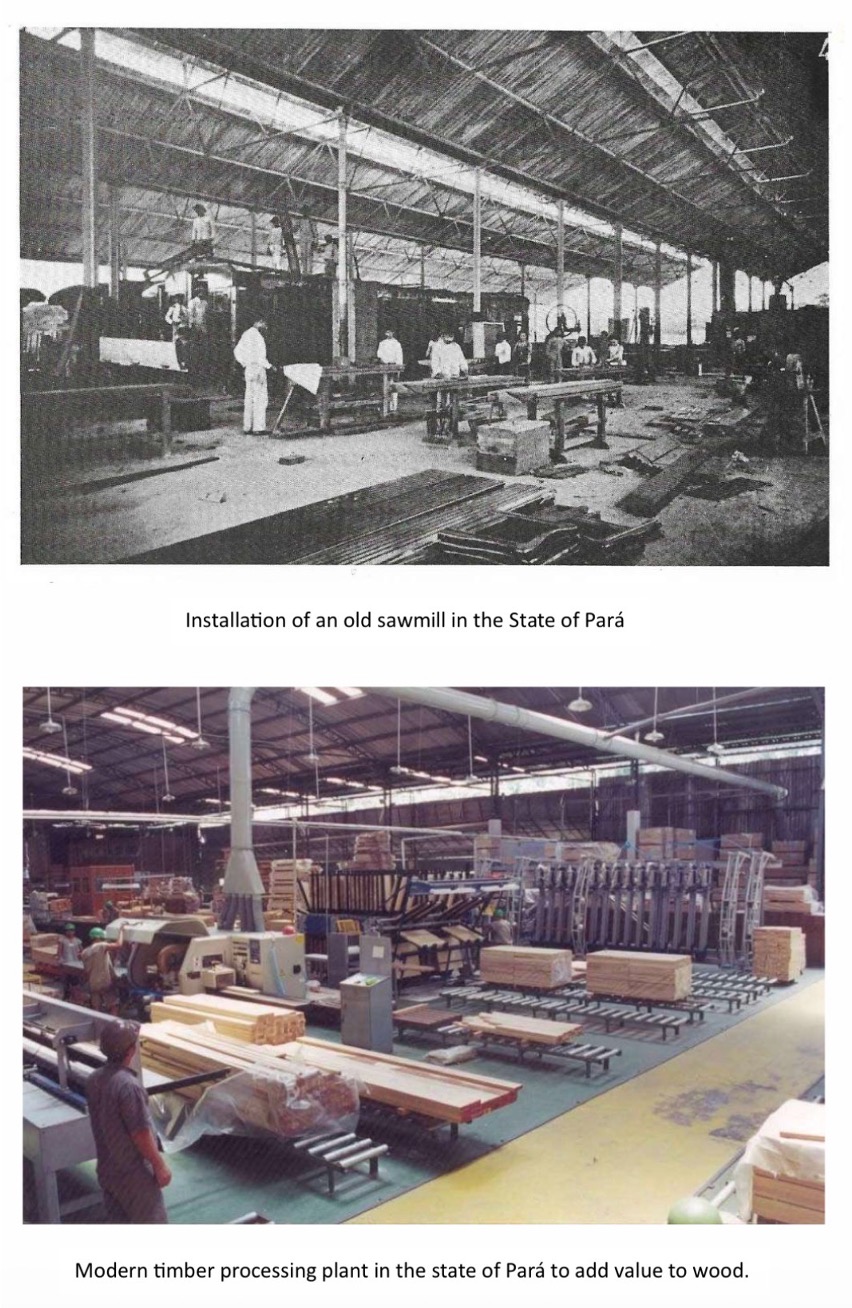
In the past, Brazil allowed the export of timber in log form. To give an idea, the majority of exports from the state of Pará (60.46%) were in the form of logs. The Associação das Indústrias Exportadoras de Madeira do estado do Pará - AIMEX (Association of Wood Exporting Industries of the state of Pará - AIMEX), understanding that to grow, add value and generate jobs, the sector needed to vertically integrate the industrialization of wood, defended the proposal to ban the export of logs. From 1989 onwards, with the aim of encouraging the export of products with increasing levels of processing and wood manufacturing, Brazil prohibited the export of logs of native species, with the exception of logs originating from planted forests, and the State of Pará began the process of vertically integrating its timber industry.
Currently, 93.96% of exports are products with high added value, with profiled wood (flooring, decks, parquet and trim) standing out with a 66.75% share.
In the last six years, the timber industry in the State of Pará has faced several challenges. The increase in interest rates by central banks in various countries to combat inflation, discouraging and restricting consumption, which arose with the disruption of the world economy due to the COVID-19 pandemic; and the complicated global geopolitical situation that also generated inflationary pressure on energy and food costs driven by the war between Russia and Ukraine, are factors that influenced the export of wood from the state of Pará.
When inflation increases, the government, through the Central Bank, raises interest rates to curb consumption. If interest rates rise, people end up restricting consumption and spending less on construction, renovations, etc. The contractionary policy affects the new housing construction industry, a major consumer of wood, as high interest rates maintained for longer periods make it difficult for borrowers to pay their mortgages. As a domino effect, the furniture industry also reduces its purchase of wood to manufacture the furniture that will furnish the new housing units, also reflecting in a drop in wood consumption.
With the improvement in the global economic scenario, mainly in the United States and the European Union, the main destinations for wood from the state of Pará, there has been an increase in exports. In 2026, wood exports grew again, registering a 30.52% increase in value and a 9.06% decrease in quantity in the first half of the year. This reflects the upward trend in average prices compared to the same period last year.
From January to June, international wood sales totaled over US$130 million, with the production of approximately 126,000 tons of wood products. The main product in the wood export portfolio continues to be profiled wood, including flooring, decks, parquet blocks, and moldings. This category alone accounted for 67.09% of the total value exported during the period.
Other highlights during this period were sawn timber and fiberboard panels, also known as MDF - Medium Density Fiberboard. This product began being exported at the end of 2021 and had been gaining traction, but the recent tariff policy of the American government on products exported from Brazil to the United States did not include some processed wood products with higher added value in the list of exceptions, among them MDF, harming the competitiveness of this product, which has that country as one of its main destinations.
Teacan logs (Tectona grandis), an exotic species originating from South and Southeast Asia and planted on a large scale in the State of Pará, also have a positive share in exports, accounting for 5.68% (US$ 7.4 million) in the first half of 2026.
The table below shows the performance of wood exports from the State of Pará in the first half of 2026.
|
PRODUCTS |
2026 |
|||
|
|
US$ FOB |
% |
Weight (Kg) |
% |
|
Profiled wood |
87.394.242 |
67,09 |
42.375.295 |
33,61 |
|
Sawn wood |
31.099.025 |
23,88 |
41.383.161 |
32,82 |
|
Raw wood, even peeled |
7.405.578 |
5,68 |
38.156.739 |
30,27 |
|
Particleboard panels |
1.419.828 |
1,10 |
2.272.560 |
1,80 |
|
Wooden articles for table and kitchen |
1.321.545 |
1,02 |
201.339 |
0,16 |
|
Handles for tools, brooms, brushes, etc.. |
642.152 |
0,49 |
448.932 |
0,36 |
|
Plywood |
357.475 |
0,27 |
374.546 |
0,30 |
|
Laminated products |
145.964 |
0,11 |
252.630 |
0,20 |
|
Other products |
460.429 |
0,36 |
609.173 |
0,48 |
|
TOTAL |
130.246.238 |
100 |
126.074.375 |
100 |
On the other hand, new challenges marked by global uncertainties, with higher inflation projections and weaker growth forecasts, will be faced by the timber industry in the state of Pará. This reflects the transmission of higher energy prices to costs, income, and confidence, which may affect market dynamics and timber export performance.
The current geopolitical conflict in the Middle East, with the opening and closing of the Strait of Hormuz, has put pressure on oil futures contracts in international markets. If the conflict extends for a long time, there is a high possibility of revising macroeconomic projections, where the energy shock has taken center stage in discussions about inflation, growth, and monetary policy in the world's largest economies.
Added to this are uncertainties regarding new international environmental control standards; changes in trade policies in foreign markets, with tariffs being suspended or altered, which could lead to a loss of competitiveness compared to other competing tropical timber producing countries, impacting production and employment; as well as internal problems such as delays in granting the necessary export licenses efficiently and within the required timeframe.
Despite the challenging and uncertain scenario, the growing relevance of the global debate on the finiteness of natural resources and the disposal of long-term degrading materials in the environment gives wood excellent prospects for the future, as it is a renewable and biodegradable natural resource, as well as a flexible, structurally strong product with the lowest embodied carbon of any commercially available commodity.
Throughout its 45 years, the Associação das Indústrias Exportadoras de Madeira do estado do Pará - AIMEX (Association of Wood Exporting Industries of the state of pará - AIMEX) has been participating in this debate on the world stage, continuing projects and actions aimed at institutionally strengthening the productive sector based on forestry and the wood industry in the State of Pará, as well as supporting and encouraging production based on sustainable forest management as a basic condition for the perpetuation of forest resources, boosting the wood industry as a vector for the sustained development of the economy and a generator of employment and income, contributing to ensuring that the populations living here can have a standard of living commensurate with the natural wealth of the region.
Author:
Guilherme dos Santos Carvalho
Forestry Engineer and consultant at AIMEX