
Ghana has become the first African country to issue a FLEGT license, a milestone celebrated in Brussels in early November. To shed light on the implications for the European market, ATIBT gathered testimony from Belgian importer STOCKMANS, which was present at the ceremony.
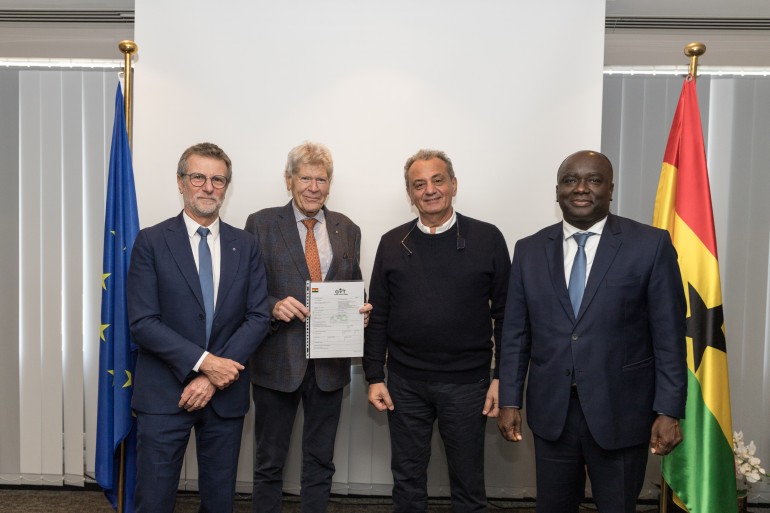
Credit @Elza Low
From left to right: Geza Strammer (DG INTPA) , Armand Stockmans (SWP - Stockmans Wood Products ) , Avedis Jeghalian ( LLL, Logs & Lumber Limited),Henry Tachie-Menson, Ambassador of Ghana .
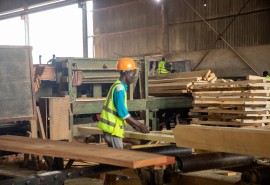
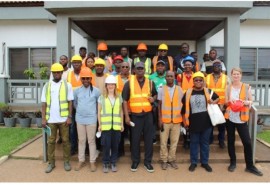
On November 4, a historic milestone was reached for the legal timber trade: Ghana became the first African country to officially issue a FLEGT license, marking the culmination of a long process undertaken under the VPA/FLEGT with the European Union. The launch ceremony, held in Brussels in the presence of a delegation from the Timber Industry Development Division (TIDD), the Ghanaian Ambassador, and EU representatives, symbolized the beginning of a new era for traceability and forest governance in Ghana.
Among the participants was Armand Stockmans, representative of the Belgian company STOCKMANS WOOD PRODUCTS (SWP), a member of ATIBT and an importer committed to responsible purchasing. We wanted to hear his thoughts and views on this major step for the European timber market, at a time when FLEGT and the EU Timber Regulation are redefining due diligence requirements.
I felt a real sense of accomplishment. After years of technical work, institutional adjustments, and efforts on the part of Ghana, seeing the first FLEGT license issued was both symbolic and concrete. There was a sense of national pride and a strong desire to enter a new phase in which the Ghanaian timber trade would be conducted with greater transparency and credibility. For us European stakeholders, it was also a positive sign: the system works, it delivers, and it has a real impact.
As responsible importers, it was essential for us to witness this moment. We have been working with Ghana for a long time, and being present was a way of supporting a partner that has made considerable efforts to meet these requirements. It was also an opportunity to discuss the practical implications for operators with the Ghanaian and European authorities.
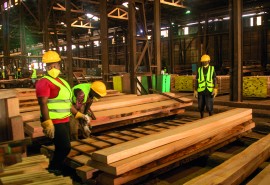
For us, it means above all a gain in confidence. A FLEGT license guarantees that the exported timber complies with national laws on forest management, taxation, processing, and transport. It is a robust, audited system that provides valuable legal certainty. In a context where due diligence is becoming increasingly complex, a framework such as FLEGT simplifies risk assessment and strengthens commercial relations with our partners.
Ghana is not our largest supplier in terms of volume, but it has always been a reliable country, with a structured industry and good quality species on offer. The arrival of FLEGT licenses is a factor that can clearly strengthen our confidence and our volumes in the future, as it reduces uncertainty and promotes the most rigorous Ghanaian companies.
For us, these tools are not opposed to each other: they complement each other. Voluntary certification adds an additional environmental and social dimension, with standards that are sometimes more demanding. The FLEGT system, on the other hand, ensures that legality is robust, controlled by the state, and backed by a national verification system. Together, they offer a very attractive continuum of assurance for European buyers.
Yes, undeniably. The EUTR requires strict due diligence, but recognizes robust national systems. FLEGT does not replace due diligence, but it simplifies risk analysis because it is based on an audited national system that is entirely focused on traceability and legality. For an importer, this means more reliable data, greater transparency, and less uncertainty, which is invaluable.
I think Ghana can become a model for other African countries. The FLEGT license is a competitive advantage: it reassures buyers, reduces perceived risk, and can strengthen the position of Ghanaian timber in a European market that is very sensitive to compliance. For us importers, it opens the door to stronger, more predictable, and long-term partnerships.
The issuance of Ghana's first FLEGT license marks a major step forward not only for the country, but for the entire legal timber trade. The testimony of SWP illustrates the importance of this milestone for European companies in a rapidly changing regulatory landscape.