
06.03.2026
The Ebony Project coordinated by the Congo Basin Institute (CBI), has released its Annual Progress Report 2025, highlighting a decade-long partnership that connects business, communities, and researchers to restore degraded forest landscapes, conserve a high-value tropical timber species, and strengthen rural livelihoods in Cameroon.
A restoration model that keeps growing
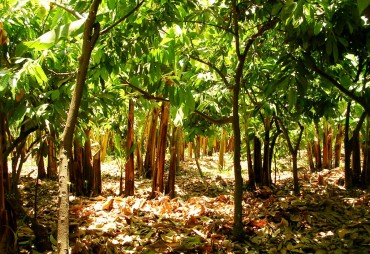
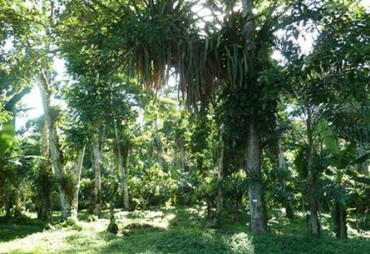
Since its launch in 2016, the project has developed a community-based planting program designed as a pilot for broader rainforest restoration efforts.
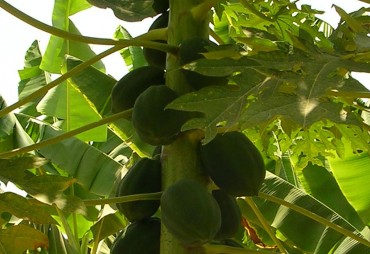
To date, participating communities have planted 81,982 trees—including 47,561 ebony trees and 34,421 fruit trees—illustrating a model that combines ecological restoration with food-security co-benefits.
In 2025, supported by Germany’s International Climate Initiative (IKI), the project expanded for the first time beyond the greater Dja Landscape by onboarding six new communities near Lobéké National Park. This eastward expansion brings both opportunity and operational complexity: the Lobéké area is significantly more remote (a “three-day drive” from Yaoundé), prompting the recruitment of an agroforestry technician based locally, and raising important questions about how the model performs where access to markets for fruit surplus is limited. Co-cropped ebony trees would not be theoretically available for harvest for a generation.
Community engagement: FPIC and the transition to “independence”
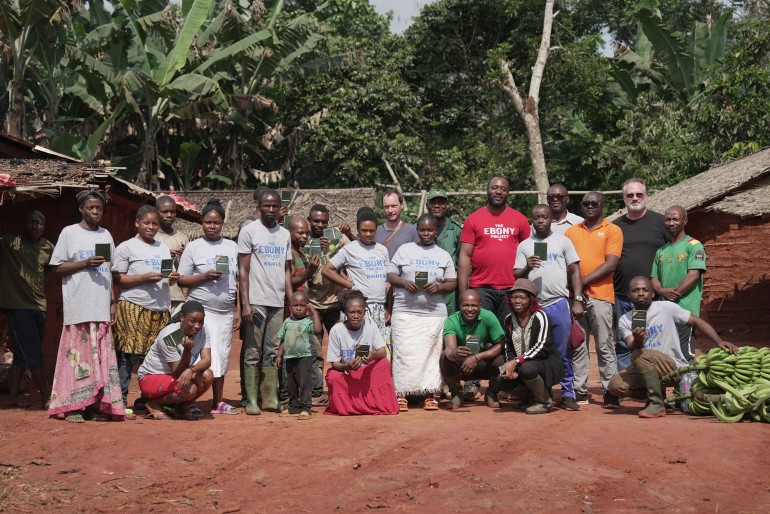
A notable operational feature is the project’s approach to Free Prior and Informed Consent (FPIC), undertaken at two levels: first, assessing collective community willingness and capacity (e.g., nursery construction); then identifying which households actually wish to plant trees on their own land. The report underscores a key field reality: active participation often comes from only a fraction of residents—an important consideration for any community-based restoration model.
Because participation and planting intensity vary widely between villages, the project has introduced a new category in its community typology—“Independent”—to reflect communities that will age out of incentive payments and no longer receive regular technical support. This is a critical next step: designing pathways for long-term maintenance beyond direct project intervention.
Science with direct implications for forest management
In 2025, the project published landmark findings in Science Advances on the interdependence between ebony and critically endangered African forest elephants, widely referred to as the “Ebony and Ivory” paper. The results are striking for anyone working on sustainable forest management and restoration:
Beyond ebony, the project is also advancing propagation of other threatened hardwood species with Fondation Franklinia support, including 2,120 mukulungu saplings (Autranella congolensis) and 490 moabi saplings (Baillonella toxisperma).
Measuring impact more rigorously: Theory of Change, KPIs, and open data ambitions
GEF7 funding has catalyzed a step-change in impact assessment. In 2025, a team of Cameroonian and American students helped build the foundations of a Monitoring & Evaluation (M&E) system, alongside the recruitment of an M&E specialist. The team developed a Theory of Change to articulate outcomes without overstating causality, explicitly distinguishing known, probable, and possible impacts.
The project is expanding its Key Performance Indicators (KPIs) beyond tree planting to encompass metrics such as hectares planted, survival rates, beneficiaries, training days, female participation, and peer-reviewed publications, among others. It has also created a Mission Report Database documenting 325 visits to communities to track trainings, follow-up, and local investments.
Looking ahead, the team plans to unveil a public-facing Tableau dashboard in 2026, while addressing growing expectations around indigenous data sovereignty and the ethical sharing of field-level information.
A pivotal moment: sustaining long-term financing
The report is candid about the funding challenge created by long biological timelines. Completing the first three community stages requires at least seven years, longer than many donor cycles. The project has relied heavily on long-term support from Bob Taylor (Taylor Guitars), who has provided $250,000–$350,000 annually since inception—support that cannot be assumed indefinitely.
While the Global Environment Facility and Fondation Franklinia provide provisional support for some communities through at least the end of GEF8 in 2033, the project is actively seeking additional funding to offset potential future gaps and enable continuation or expansion—possibly into neighboring Congo Basin countries.
Read the full Annual Progress Report 2025 (Ebony Project) for details on results, methods, and next steps.
All Annual reports and key project documents can be found at crelicam.com/resources.
ATIBT channel on YouTube
ATIBT channel on YouTube