
Development of Competitive and Sustainable Timber Value Chains in Central Africa Through Market-Adapted Products and the Utilization of Underutilized Timber Species (LUTS)
To utilize underutilized timber species to diversify supply, meet the needs of the European market, and strengthen the competitiveness and sustainability of the timber sector in Central Africa.

Background
The forestry and timber sector in the Congo Basin is undergoing a major transition. For a long time, it relied on a few flagship tree species that were well known to international markets. Today, this model is showing its limitations.
As concessions gradually enter their second rotation, available volumes are decreasing, tree diameters are smaller, and log quality may be lower. At the same time, international requirements regarding sustainable management, traceability, and regulatory compliance—particularly those related to CITES and European regulations—are becoming stricter.
In this context, promoting lesser-known or underutilized species—Lesser-Used/Lesser-Known Timber Species (LUTS/LKTS)—presents an opportunity to diversify the harvested resource, better distribute harvesting pressure, and strengthen the sector’s economic and ecological resilience.
However, the development of these species in international markets—particularly in Europe—still faces a major challenge: trust. Without reliable data on their durability, stability, fire performance, or the consistency of their supply, architects, manufacturers, insurers, and distributors are reluctant to incorporate them into their projects and product lines.
Why this project?
Diversifying the tree species harvested would help distribute harvesting pressure more evenly, extend forest rotations, strengthen the resilience of sustainable management models, and increase the volumes available to industry, while contributing to carbon sequestration and the preservation of the ecological balance of the Congo Basin’s forests.
The project addresses a twofold challenge. First, it aims to ensure the technical and commercial viability of underutilized tree species in order to reduce the perception of risk that hinders their adoption.
Second, it aims to structure the value chain, from the forest resource to the European market, including industrial processing in the Congo and Gabon. These issues of trust, performance, compliance, and ensuring safe use are at the heart of the strategy defined in the agreement between the FAO and ATIBT.
This approach thus moves beyond a focus solely on promoting new tree species to the development of high-performance, standardized wood products tailored to market requirements.
This strategy is based on three complementary levers:
■ Developing Demand
Promoting the adoption of LUTS products in the European market, particularly through the production of reliable technical data, their integration into standardization and certification systems, and the development of prototypes, demonstrators, and real-world applications.
■ Strengthening supply
Developing a competitive, reliable, legal, traceable supply in the Congo and Gabon that meets European market standards, notably by improving processing methods, product quality, and the consistency of supply.
■ Mobilize investments and financing
Facilitate access to the financing needed for the development and scaling up of LUTS value chains, notably through feasibility studies, business plans, investment projects, and engagement with financial institutions.

A grant mechanism to support the private sector
The project is part of the EU Forest Governance and Value Chains (FGVC) program, implemented by the Food and Agriculture Organization of the United Nations (FAO) and funded through the European Union’s Global Gateway initiative.
The operational core of the project is a direct grant mechanism for companies, with a budget of 1.4 million euros. It is open to companies based in Congo, Gabon, and the 27 Member States of the European Union.
This mechanism covers three areas: developing demand for LUTS products in the European market, strengthening supply from the Democratic Republic of the Congo and Gabon, and mobilizing funding to support the development of the sector.
Two levels of grants are available: Projects may focus on the production of technical data, standardization and certification, the development of prototypes and demonstration products, the improvement of processing methods, traceability and legality, the preparation of industrial and investment projects, and more.
The Role of ATIBT and FAO
The FAO, through its “EU Forest Governance and Value Chains (FGV) Program,” oversees and manages the grant mechanism (i.e., calls for proposals, proposal evaluations, contract negotiations with beneficiary companies, disbursement of funds, technical monitoring, and audits) and provides support to ATIBT. ATIBT contributes at several levels.
- First, it promotes the grant mechanism among private-sector stakeholders in Europe, the Congo, and Gabon, and assists interested companies in developing their project proposals.
- Once beneficiaries have been selected, ATIBT also provides them with tailored technical support based on their needs, particularly in the areas of timber and forestry expertise, project management, finance, and compliance.
- ATIBT also engages with government agencies, standards-setting bodies, and competent authorities—primarily within the EU—to promote greater consideration of LUTS/LKTS tree species in the regulatory, standards-based, and technical frameworks applicable to wood products.
- Finally, it engages financial institutions and investors to improve their understanding of investment opportunities related to LUTS/LKTS value chains and to facilitate access to financing for the sector.
Under the grant mechanism, ATIBT supports applicants but does not participate in the evaluation or selection of proposals. It may observe the deliberations of the technical and selection committees.
Beneficiaries and Areas of Intervention
The project is aimed at companies operating along the tropical timber value chain. It targets producers and processors based in the Congo and Gabon, as well as importers, distributors, and end users established in the European Union, particularly companies, architects, engineering firms, and manufacturers.
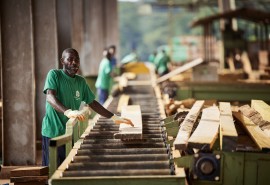
Activities are therefore carried out on two levels: in the Congo Basin for production and processing, and in the European market for demand and market opportunities.
Three expected outcomes of ATIBT’s actions
Companies involved in the LUTS/LKTS value chains in Europe, the Congo, and Gabon are mobilized and supported to develop projects aligned with the grant mechanism’s priorities.
In particular, ATIBT promotes the mechanism, assists with the formulation of proposals, and provides technical support to selected beneficiaries.
The relevant government agencies and organizations in European Union member states are being further mobilized to integrate LUTS/LKTS tree species into the regulatory, standard-setting, and technical frameworks applicable to wood products.
Discussions and recommendations may focus, in particular, on the diversification of tree species in public procurement, certification schemes, technical standards, and regulatory or normative barriers limiting their use.
Financial institutions and investors have a better understanding of investment opportunities related to LUTS/LKTS value chains and are more actively engaged in financing them.
The project aims, in particular, to raise awareness of the sector’s needs, identify barriers to accessing financing, and encourage solutions tailored to the specific characteristics of tropical timber value chains.
Duration and Funding Contact:
For any questions regarding support for companies applying for the grant mechanism: