
08.12.2025
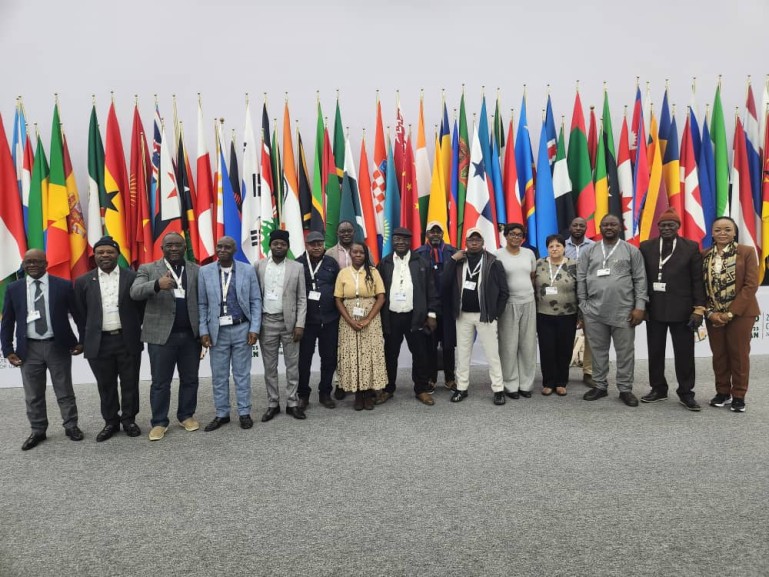
From November 24 to December 5, 2025, a delegation from ATIBT and FRMi accompanied Central African countries to the 20th Conference of the Parties (CoP20) to CITES in Samarkand (Uzbekistan). The aim was to defend the legal, sustainable, and traceable trade in tropical species from the Congo Basin and to represent the region in increasingly technical and sensitive debates.
Two major proposals, presented by the Republic of Congo and Gabon, aimed to remove the populations of Central Africa from Afzelia bipindensis (doussié) and Pterocarpus soyauxii (Padouk) from Appendix II. To support these requests, the delegations presented strong scientific arguments based on: confirmed abundance of resources, estimated at nearly 20 million mature trees for each species; more than 30 years of forest management, demonstrating the resilience and renewal capacity of the stands; and traceability and control systems such as SIGIF or SILV/SVL, covering the entire forest-to-port chain.
Despite these elements, the proposals did not obtain a qualified majority (47% of votes in favor against the 66% required). Nevertheless, this result remains encouraging; it shows that the scientific arguments of the subregion are gaining recognition and that a significant coalition already supports an approach based on sustainable management and not solely on the precautionary principle.
One of the most sensitive issues for Central Africa concerned delays in the issuance of import permits, particularly within the European Union. Doc. 48, sponsored by Cameroon, summarized the context: many operators reported delays of up to 18 months, while CITES export permits expire after six months.
Following negotiations on Doc. 48, a compromise emerged:
To support these developments, Central African countries have decided to set up a permit tracking tool to document actual processing times and provide a solid factual basis for future exchanges with the EU, other importers, and CITES authorities.
CoP20 also gave rise to strategic discussions on the look-alike criterion and how to more effectively coordinate the processes for listing species in Appendix II of CITES. Central African countries advocated a more risk-based approach to avoid the “precautionary” listing of species that are not biologically threatened but are essential to legal industries.
This vigilance was reinforced by the presentation of information document Inf. 51 by Germany. This document indicates that several plant taxa, including Entandrophragma spp. (sipo, sapelli, tiama, kosipo), are now among the priority species to be reviewed. This prioritization is based on: (i) the importance of these species in international trade, (ii) the presence of potential risk signals, and (iii) identification difficulties that could trigger the “look-alike” criterion. This clearly indicates that Entandrophragma spp. could be at the heart of the upcoming discussions at the next CoP.
Following CoP20, ATIBT and COMIFAC have identified several priorities for action: