
12.06.2026
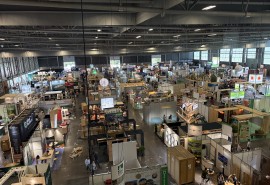
A highlight of the 2026 Carrefour International du Bois (International Timber Fair) With six months to go before the EU Deforestation Regulation (EUDR) takes effect, questions are no longer limited to the regulation’s content but also focus on its practical implementation. How are companies preparing? What will the competent authorities actually be checking? How are producers responding to the new expectations of European importers? To address these questions, ATIBT brought together an exceptional panel at the Carrefour International du Bois in Nantes, featuring French and Dutch competent authorities, major European importers, and representatives of the tropical forestry sector. A rare opportunity to examine the on-the-ground realities across the entire supply chain.

A panel representing the entire supply chain
This diverse group of speakers allowed for a comprehensive examination of the regulation from all angles: regulatory compliance, operational data management, producer preparedness, authority oversight, and supporting tools.
After the turbulence of 2025, the fundamentals remain
To open the session, ATIBT presented the latest developments regarding the EU Deforestation Regulation and the clarifications published by the European Commission in May 2026.
A key message emerged from the discussions: despite the changes introduced at the end of 2025, the fundamental requirements of the regulation remain unchanged. The products in question must be legal, free from deforestation and forest degradation, traceable to their origin, and covered by due diligence.
For suppliers located in producing countries, the information expected by European importers therefore remains largely the same: geolocation, traceability, legality, and proof of compliance.
Importers: Time for Implementation
Testimonials from Jean-Max Peronne (Saint-Gobain) and Dominik Mohr (CID Bois Tropicaux) highlighted the challenges facing European operators.
The main challenge is no longer understanding the regulation but building due diligence systems capable of managing a considerable volume of data, verifying its consistency, and demonstrating control over the risks associated with supply chains.
The speakers also highlighted an important point: the EU Deforestation Regulation is accelerating the professionalization of procurement practices. Companies must now have a better understanding of their suppliers, their control systems, and the production conditions of the timber they place on the European market.
Producers: The EU Deforestation Regulation as an Opportunity Rather Than a Threat
Vincent Istace’s (Olam Agri) testimony offered a different perspective, one often missing from European debates.
While the EU Deforestation Regulation is sometimes portrayed as a threat to tropical producers, he advocated for a more positive interpretation. For companies long committed to sustainable management and certification, the regulation’s principles largely align with existing practices: product traceability, monitoring of forestry operations, concession oversight, and independent verification.
Beyond compliance, Vincent Istace also raised a more strategic question: how can we ensure that the costs and investments made upstream in the supply chain are recognized and valued in the markets? This question goes far beyond the scope of the EU Deforestation Regulation alone and points to the economic future of sustainable tropical forest management.
A highlight: the expectations of competent authorities
The presence of Tieme Wanders, representative of the Dutch competent authority (NVWA), and Arthur Quinquenet, representative of the French competent authority, was one of the highlights of this roundtable.
The companies in attendance were thus able to hear directly from the agencies that will be responsible for enforcing the regulation starting in December 2026.
The authorities presented the preparatory work underway in their respective countries: pilot inspections, team preparation, exchanges between Member States, and harmonization efforts.
The results of the “dry runs” conducted by the NVWA notably showed that many companies have already begun implementing due diligence systems, but that the quality of risk assessments and mitigation measures remains highly variable. An important lesson emerged: due diligence is not limited to collecting documents. The authorities will seek above all to verify the overall consistency of the system implemented by the company.
Certification: Encouraging Signs
Another topic of particular interest to the sector: the role of certification within the EUDR framework.
Dutch authorities presented their ideas for better integrating certain certification systems into their risk-based supervision approach. They specifically noted that they have recognized the governance of systems such as FSC and RSPO as a working basis for further consideration.
The message is clear: certification does not replace due diligence and does not exempt companies from inspections. However, it can help build trust, reduce certain information-gathering efforts, and improve the effectiveness of risk-based inspections.
For certified supply chains in the Congo Basin, which have been investing for decades in traceability, legality, and sustainable management, this is a particularly encouraging sign.
Practical resources to support companies
The roundtable also served as an opportunity to present several tools designed to assist operators in their preparation for the EU Deforestation Regulation.
Presented by Alessandra Negri, the Timber Trade Portal (TTP) continues to evolve to meet the new expectations of companies facing the EU Deforestation Regulation.
This reference platform provides detailed information on national regulatory frameworks, legality documents, traceability systems, and applicable requirements in the main producing countries. It is now a valuable resource for operators seeking to strengthen their due diligence.
New ATIBT Brochures
ATIBT also presented two new publications:
EUDR & Certified Tropical Timber: Practical Guidelines for European Importers, which explains how certified supply chains can contribute to assessing and mitigating EUDR risks;
Sustainable Management of Certified Forests: What You Don’t See Makes All the Difference, which highlights the sustainable management, traceability, and monitoring mechanisms implemented in certified concessions in the Congo Basin.
From Compliance to Value Creation
Beyond regulatory aspects, this roundtable raised a fundamental question: will the EU Deforestation Regulation be merely a compliance exercise, or will it also help better recognize supply chains that invest in sustainable management?
For both producers and importers, the regulation’s success will also depend on its ability to promote transparent, legal, and responsible supply chains.
With six months to go, one thing seems certain: preparations for the EUDR have now entered their final phase. The rules are known. The authorities’ expectations are becoming clearer. It is now up to all stakeholders in the sector to turn this regulatory requirement into an opportunity for differentiation and trust.