
30.10.2026
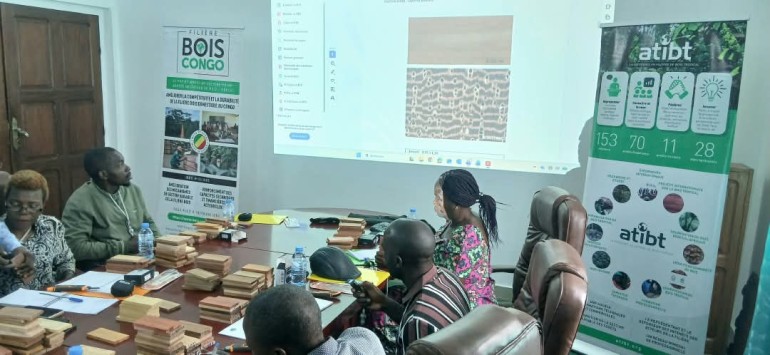
From 22 to 24 October 2026, fourteen participants attended a practical training course in sawn timber identification in Pointe-Noire, organised by ATIBT Congo under the European Union-funded ASP – Domestic Timber Market project. The first in a series of sessions also planned for Brazzaville and Ouesso, the course aims to strengthen professional skills and encourage the use of a wider range of timber species.
Identifying a timber species is an essential step in selecting wood suited to its intended use. However, the domestic timber value chain assessment conducted under the MIB Congo project highlighted limited species knowledge among some timber sellers, joiners and cabinetmakers. Generic descriptions such as “red wood” or “white wood” do not reflect the diversity of timber properties and potential applications.
To address this need, ATIBT Congo has launched a series of three training sessions for professionals involved in timber trading and processing. The aim is to provide methods for identifying species, broadening material choices and helping reduce pressure on traditionally preferred timbers.
Training based on observation and hands-on practice
Hosted in a room provided by the National Reforestation Service, the Pointe-Noire session brought together professionals from Pointe-Noire and Dolisie, alongside two teachers from technical schools specialising in timber trades. Their participation was arranged at the request of the Menuiserie Blum project, implemented by IECD Congo.
Led by Achille Tsieta, the training combined the basic knowledge needed to understand wood with extensive exercises using samples. Participants learned to distinguish cutting planes and examine features visible to the naked eye, including colour, smell, texture, grain, hardness and density assessed by handling.
Using hand lenses, they then explored wood anatomy, particularly vessels, parenchyma and rays. These features provide additional criteria for distinguishing species that may look similar.
The session also covered timber names, species that are easily confused, species protected in Congo and those listed under CITES.
Sharing skills within professional organisations
Beyond individual learning, the initiative encourages participants to pass on their knowledge to members of their professional associations and groups. Involving teachers also helps disseminate these skills among future timber professionals.
Active participation and numerous questions throughout the practical exercises generated lively discussions. Participants expressed their interest in further training sessions reaching a wider audience. The course concluded with the presentation of certificates of participation.
Further sessions in Brazzaville and Ouesso
Two further sessions are scheduled for 29–31 October in Brazzaville and 24–26 November 2026 in Ouesso. The series aims to train a total of 45 domestic timber sector stakeholders.
Through this initiative, the ASP – MIB Congo project continues to support the organisation and strengthening of the private sector. Better species knowledge enables professionals to advise customers more effectively, select suitable materials and make better use of the diversity of timber available on the domestic market.
This activity is carried out under the ASP – Domestic Timber Market project in the Republic of Congo, funded by the European Union and implemented by ATIBT Congo.