
06.02.2026
The PhD Thesis of Crispin Ilunga-Mulala Mushagalusa, Gembloux Agro-Bio Tech, University of Liège demonstrates that when carried out in compliance with legal standards, logging in Central Africa has a limited impact on forest cover with only one to two trees harvested per hectare every 25 to 30 years.
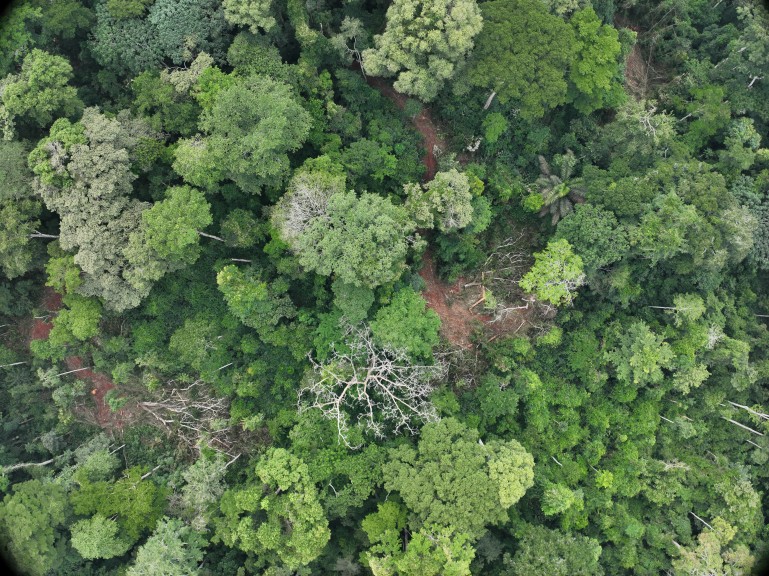
However, this model relies on a restricted number of species (around thirty), some of which exhibit low regeneration capacity in natural forest. The most affected are light-demanding species. This results in the progressive depletion of their populations and a decline in profitability over the relatively short term. Therefore, developing pragmatic silvicultural approaches based on assisted or artificial regeneration is necessary to ensure the long-term sustainability of timber harvesting. They can also prevent the conversion of forest land to other more lucrative activities.
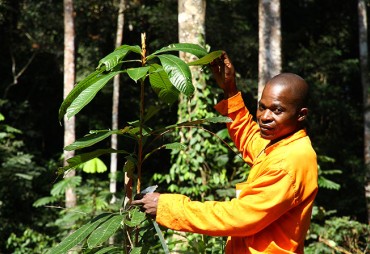
The general objective of this thesis is to identify the most effective silvicultural practices for ensuring the regeneration of logged species within forest concessions in Central Africa. More specifically, it seeks to determine the factors influencing the survival and growth of high-value local timber species planted in openings created by logging operations, such as logging gaps, former log yards, and degraded areas along roads. The research was conducted in two forest concessions in south-eastern Cameroon that initiated enrichment activities 19 years ago.
The results of this thesis indicate that in logging gaps, five species – Detarium macrocarpum Harms, Erythrophleum suaveolens (Guill. & Perr.) Brenan, Terminalia superba Engl. & Diels, Baillonella toxisperma Pierre and Prioria oxyphylla (Harms) Breteler – had survival rates above 80 % over a period of 14 to 19 years. In contrast, all seedlings of Entandrophragma cylindricum (Sprague) Sprague planted have died after 15 years. Terminalia superba exhibited the highest diameter (16 mm·year-1) and height (103 cm·year-1) growth. Lovoa trichilioides Harms and B. toxisperma had diameter increments higher than 2 mm·year-1. This study recommends enriching logging gaps with T. superba and, if regular maintenance is ensured, also planting B. toxisperma, E. suaveolens, and D. macrocarpum.
In former log yards, annual seedling survival ranged from 59 % to 98 % depending on the species after six years. The highest diameter growth was recorded in T. superba (21 mm·year-1) and Pterocarpus soyauxii Taub. (12 mm·year-1). Soil ripping with bulldozer claws down to 40 cm had a positive effect on T. superba, while log yard size had no effect on species performance. The study recommends enriching former log yards with T. superba and P. soyauxii. Since soil ripping has limited effect on most species, investment should instead focus on the removal of competing vegetation.
In opened secondary forest areas, annual survival rates ranged from 67 % to 99 % after 15 years, depending on species, saplings age, and tending methods. Piptadeniastrum africanum (Hook.f.) Brenan had the highest survival rate (99 %) after 14 years. Diameter increment depends on species, proximity to open areas (e.g., roads), tree age, plot preparation, and tending methods. The highest mean diameter increments (10 – 13 mm·year-1) were recorded for Bobgunnia fistuloides (Harms) JHKirkbr. & Wiersema, Triplochiton scleroxylon K.Schum., Distemonanthus benthamianus Baill. and Pseudospondias microcarpa (A.Rich.) Angl.
It is recommended to enrich timber-production forests in Central Africa with local species. Fully open areas, including deforested sites outside forest concessions, could be restored with species that are difficult to establish in opened secondary forest areas. The influence of fauna on seedling mortality, especially for E. cylindricum, deserves further investigation to develop strategies tailored to herbivory-sensitive species. For species with irregular fruiting or whose seeds are heavily predated, the study of conservation methods is valuable. Experiments combining genotypic, phenotypic, and environmental factors would help to better identify the determinants of performance in vulnerable species. Finally, analyses of carbon and economic balances, complemented by long-term projections, would allow for a more precise assessment of the sustainability and profitability of enrichment planting.
This study is part of the UFA-Reforest project led by ATIBT in partnership with Nature+ asbl, Gembloux Agro-Bio Tech - Université de Liège, ENSET Université de Douala, PALLISCO-CIFM, AlpiCam-GrumCam, SEFAC et SEEF S.A. with financial assistance of the European Union.