
30.04.2026
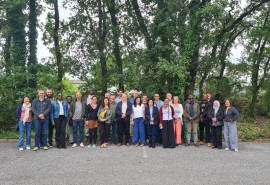
From May 11 to 15, 2026, some thirty forestry experts from the three tropical continents will gather in Montpellier to rethink selective forestry practices. Organized under the auspices of the TmFO network and IUFRO, this workshop aims to lay the groundwork for a groundbreaking scientific synthesis on the long-term sustainability of forest harvesting—whose findings will be directly addressed to industry stakeholders, including ATIBT.
The tropical forest is entering a new era. Since the majority of production forests have already been harvested at least once, forest managers and decision-makers are now faced with a central question: do current practices ensure the sustainability of second and third harvest cycles? It is precisely this question that the scientific project launched by the TmFO (Tropical Managed Forest Observatory) network seeks to answer, in partnership with the IUFRO Tropical Forestry Division, the Precious Forest Foundation, and the Smithsonian Institute’s GEO-Tree network.
A Founding Workshop in Montpellier
From May 11 to 13, 2026, approximately 30 researchers specializing in tropical forest ecology and management, from Central Africa, West Africa, Latin America, and Southeast Asia, will gather at CIRAD in Montpellier. The goal of these three days of intensive work is to define the methodology and framework for a systematic review of the scientific literature on the long-term impact of selective logging on timber production. On Friday, May 15, a videoconference session will allow key players in certification—FSC and PEFC—as well as forestry operators to join the discussions.
Three main questions structure this program: Which harvesting regimes ensure sustainable production on a tropical scale? How do different cutting regimes affect both production and conservation values? And what changes in forest management practices are needed for the future?
The work will draw on the expertise of researchers involved in the TmFO network, some of whom will meet the previous week as part of the BIOFOREST project, funded by the French Foundation for Biodiversity (FRB-Cesab).
Why this project is crucial for the sector
Available studies agree: only long rotations (over 60 years), combined with reduced harvesting intensity and diversification of commercial tree species, can ensure the long-term productive viability of tropical forests. In a context where markets are becoming more stringent—European regulations on deforestation (EUDR), growing demands for legality and traceability—having a robust scientific foundation to guide practices is no longer a luxury, but a necessity.
This project, co-funded by the Precious Forest Foundation and the Geo-Trees network (Smithsonian Institute), offers the tropical timber sector a rare opportunity: to help shape the standards of sustainable forestry for the future by being an active participant in the scientific process from the very beginning.
ATIBT will closely monitor the work resulting from this workshop and will keep you informed of the project’s progress in upcoming issues of the Newsletter.
Contact: sist@cirad.fr