
13.02.2026
On February 9 2026, ATIBT and UICCB co-organised an online consultation workshop on the proposed revision template of the Timber Trade Portal (TTP) website. A second workshop, held in English, is scheduled for 16 February at 4:00 pm.
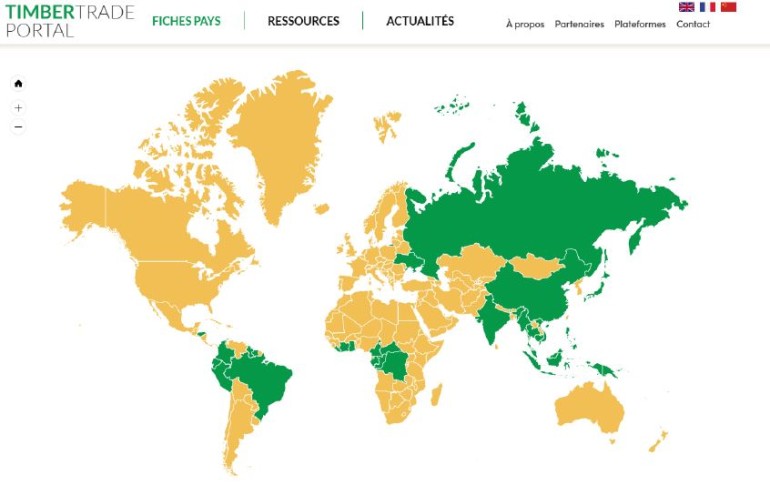
More than fifty participants – importers, traders, professional organisations, certification bodies and NGOs – attended the session to validate the main orientations of the future version of the TTP platform. The updated portal aims to support companies and Competent Authorities in achieving compliance with the access to market regulations, such as European Union Deforestation Regulation (EUDR), but also Lacey Act, etc.
TTP update objectives
The existing platform, initially developed for the EU Timber Regulation (EUTR), must evolve to integrate the new requirements of the EUDR, which will enter into application in December 2026.
The main objective is to transform the TTP into an operational risk analysis and due diligence tool, specifically tailored to the needs of timber sector operators under the EUDR framework (and other access to market regulations).
Major Proposed Revisions
The revision primarily concerns the structure of the country profiles, which form the core of the portal. The proposed template reorganises the existing tabs to align them with a structured risk assessment approach.
The “Forest Context” tab would become “Context and Risks”, directly integrating indicators on deforestation and forest degradation, as well as risk dashboards based on sources such as Transparency International, WWF and the European Commission.
The “Timber Industry” tab would evolve into “Supply”, with the aim of better mapping supply chains and identifying risk levels depending on the source (natural forest, plantation, concessions, etc.). This section would include practical mapping tools and model supply chain examples by country.
A major revision also concerns the “Key Documents” section, which would be restructured around seven categories corresponding to EUDR requirements:
Each category would present a maximum of two core documents, accompanied by visual examples to facilitate verification.
The legal framework section would now integrate CITES aspects as well as the broader environmental and social requirements introduced by the EUDR, and would provide practical tools for import and export licence applications.
User Expectations and Feedback
Participants highlighted the need for a more targeted tool than existing analyses, which are often considered either too general or too detailed.
During the discussion, several points were raised:
Timeline and Outlook
The project foresees:
A presentation of the updated portal will be done at the next Carrefour International du Bois in Nantes.
The chosen approach aims to develop a pragmatic tool capable of genuinely supporting companies in their due diligence process, without replacing their legal responsibility.
The success of the project will depend on maintaining a balance between comprehensive information and operational accessibility for end users.
For any questions or comments, please contact Alessandra Negri (alessandra.negri@uiccb.fr
An initiative supported by the TTT project
The project is part of the Tropical Timber Trade Facility program, funded by German development cooperation, within which ATIBT plays a technical role. The TTP is a central tool of this initiative, designed to provide reliable and up-to-date information on the regulatory frameworks of timber-producing countries.