
13.02.2026
In this week's newsletter, we present an overview of the various physical and mechanical properties of wood.
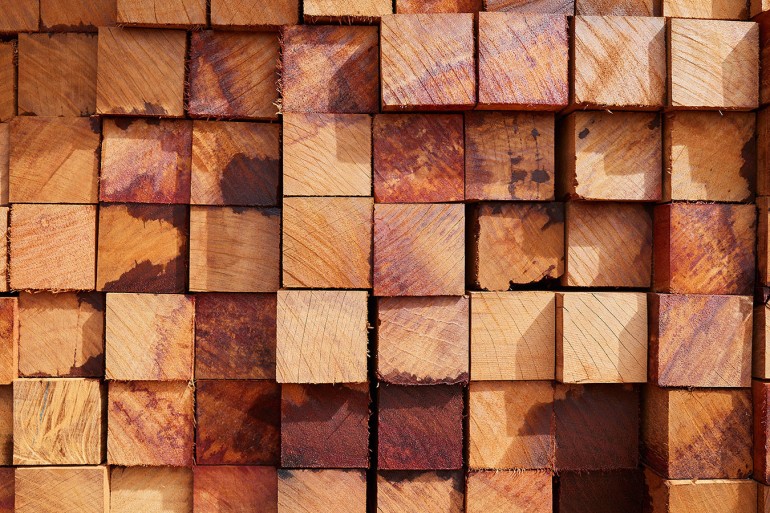
Density:
Wood is characterized by its density, denoted by ρ, which is equal to mass divided by volume. However, wood is a material that absorbs and loses water: its mass and volume depend on humidity. The moisture content at the time of measurement must therefore always be specified. In analyses, the density is generally measured for wood with a moisture content of 12%. Here, we refer to relative density, obtained by dividing the density of the material by the density of water.
Density provides us with a great deal of information about the different properties of wood (rigidity, fire behaviour, ease of use, etc.).
Monnin hardness:
Monnin hardness is a property that provides an index measuring the resistance of wood to indentation. This indicates how resistant wood is to marking (fingerprints, heel marks, impacts, punctures). In practical terms, it is measured by the depth of the indentation left by a cylindrical shape to which a given force is applied.
The volumetric shrinkage coefficient:
The volumetric shrinkage coefficient of wood is the percentage decrease in its volume when it changes from a wet state (generally close to the fibre saturation point) to a dry, anhydrous state (0% moisture content). It therefore expresses the relative change in volume due to drying, in %. This measurement is useful for anticipating cracks and deformations.
Tangential, radial and longitudinal shrinkage:
Wood is an anisotropic material. This means that it does not have the same properties depending on the direction in which it is stressed or measured. In the case of shrinkage, wood deforms differently depending on the tangential, radial or longitudinal directions. Longitudinal shrinkage is very low compared to tangential and radial shrinkage. Total tangential shrinkage and total radial shrinkage are usually determined to characterise the behaviour of wood during drying or, more generally, during changes in humidity.
Ratio Tangential shrinkage, radial shrinkage:
This ratio identifies the extent to which tangential shrinkage is greater than radial shrinkage. Tangential shrinkage is almost always greater than radial shrinkage. This data is used to predict the dimensional stability of wood and its risk of deformation during drying.
Fibre saturation point:
In green wood, free water fills the cellular voids and is evacuated during drying without causing shrinkage. Once this water has disappeared, only the water bound to the walls remains: its elimination causes shrinkage and deformation. The fibre saturation point corresponds to the moisture content at which the wood is saturated with bound water. Below this threshold, the wood contracts as it dries.
Thermal conductivity:
Thermal conductivity (denoted by λ, "lambda") describes a material's ability to transmit heat. Wood has low thermal conductivity compared to concrete or steel, meaning it provides better insulation. Given the different types of wood that exist, thermal conductivity can change. For example, as wood is anisotropic, conductivity may differ slightly depending on the direction of the fibre.
Compressive strength:
Compressive strength is the maximum stress that can be applied to a material without causing it to break. In wood, several phenomena can be observed: crushing, local buckling, cracking. Wood is generally used in compression when the compression is parallel to the fibres. The maximum stress is then higher than when the compression is perpendicular to the fibres.
Static bending strength:
Static bending strength is used to determine how far a piece of wood can bend before breaking, and therefore to correctly design and select wood (or other materials) for elements subject to bending stress. This value depends heavily on the grain orientation, knots, moisture content and mechanical class.
Longitudinal modulus of elasticity:
The modulus of elasticity (denoted by E, or "Young's modulus") is a measure of a material's stiffness: it indicates the extent to which it deforms elastically when stress is applied to it.
You can find more information on our website in the technical publications section, specifically in technical works such as:
Performance & Functional requirements guide for structures using african tropical timber
Guide to the local use of central african woods